
Watch the narrated one-pager.
Summary: Transmission is the part of the electric system that moves power from where it is made to where people use it. It is usually a small part of a monthly electric bill. For a typical $150 bill, transmission is about $15. Investing in transmission can also help lower overall costs by reducing grid congestion, improving reliability, and avoiding more expensive solutions.
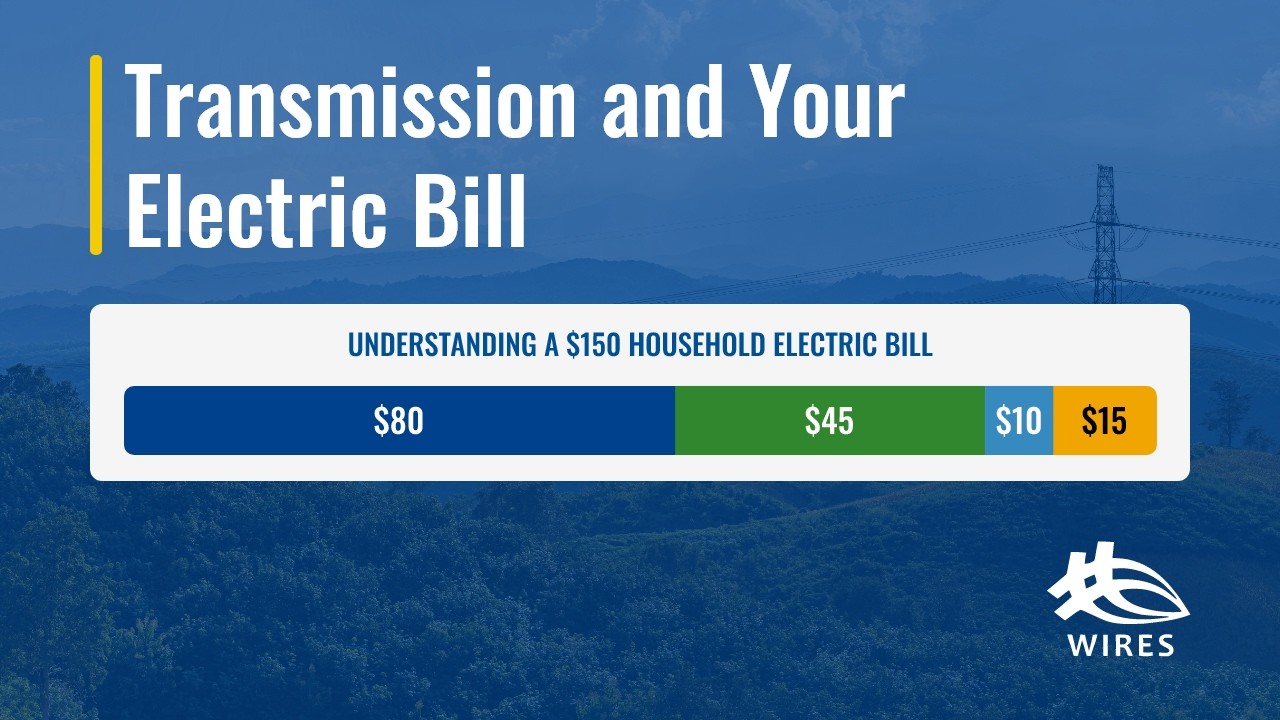
UNDERSTANDING A $150 HOUSEHOLD ELECTRIC BILL 1

Transmission costs make up a small slice of a monthly electric bill – even as grid investment increases.

Transmission Is a Small Slice of a Monthly Electric Bill, Approximately 10-20%
For a typical $150 electric bill, transmission costs account for about $15, far smaller than generation (~ $80) or distribution (~ $45). Even with increased investment, transmission remains the lowest-cost of the major power system components.
Modest changes in transmission rates are often outweighed by the system-wide savings transmission delivers – lower energy costs, reduced congestion, and avoided need for new generation. Transmission investment also improves reliability and reduces the risk of costly and dangerous outages to customers and society.
Transmission Lowers Total Customer Costs
Transmission acts like a highway that connects consumers to less expensive power and eliminates costly bottlenecks, while improving system reliability and resilience.
When an area lacks sufficient transmission, consumers pay “congestion” costs. Congestion occurs when electricity from lower-cost sources cannot reach customers due to overloaded transmission lines. Various independent studies have found:
- Congestion costs can total tens of billions annually. In 2024, nationwide congestion costs exceeded $8B, continuing a steady upward trend 2
- Transmission investment routinely cuts congestion costs by $100M+ annually
- Transmission infrastructure provides maximum savings and benefits during peak and stress events – when customers are most vulnerable to price spikes
TRANSMISSION DELIVERS CUSTOMER BENEFITS
$10+ Billion
Multiple studies show transmission investment could save U.S. consumers more than $10B annually. 3
Transmission Avoids More Expensive Alternatives
Not investing in transmission can lead to higher costs for customers due to:
- Building additional power plants that operate only a few times per year
- Increased costs for backup power and grid support services
- Greater exposure to congestion and reliability events
Download a PDF of the one pager: Transmission and Your Electric Bill [PDF, 92.28 KB]
Sources:
- EIA — Electricity Explained: Factors Affecting Electricity Prices. The figures represented also include an estimate of State Mandates and Taxes which vary from state to state and include costs for energy efficiency and low-income assistance programs and taxes. ↩︎
- Grid Strategies LLC — Transmission Congestion Costs in the U.S. for 2024 [PDF] ↩︎
- DOE — 2024 Transmission Impact Assessment [PDF], Grid Strategies LLC — Large-Scale Transmission Deployment Saves Consumers Money [PDF] ↩︎